Hough's Measure of the Season
Harry made the opening impression, but Ted Hough supplied the sustained argument. Across five double-race meetings, GPL Championship 3 rewarded a driver whose victories were supported by an almost unbroken presence near the front, whatever car he brought to the task.
The lead changes hands
There were ten races in GPL Championship 3, but the Championship was measured in five Sunday meetings, each carrying a combined round score. That distinction mattered. A fine individual race could establish a reputation; a sound pair of results did more for the title. With the poorest round discarded only when the final table was settled, the running totals also required a little perspective. The season belonged not simply to the quickest man on a particular afternoon, but to the driver who most regularly made both races count.
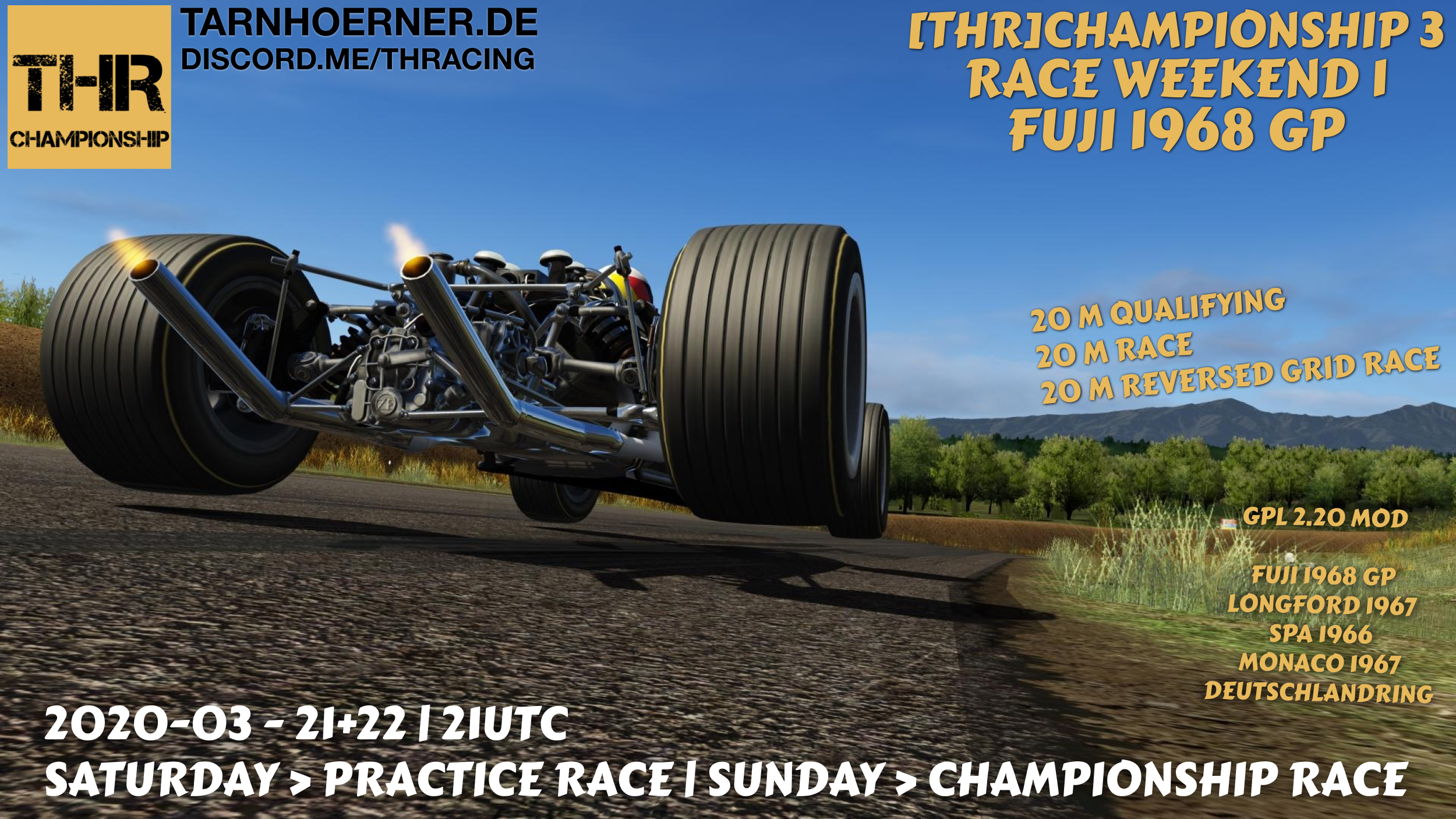
At Fuji, that driver appeared to be Harry. His Eagle T1G won the opening race and finished second in the other, giving him 57 points against Hough's 51. Hough, in the Mclaren M5A, had finished second and third: a thoroughly useful beginning, though not yet the performance by which the season would be remembered. Waffles took the second race in a Lotus 49, while Technoluddite put the Cooper T81B on the opening podium. There was variety at the front, and no immediate suggestion that one combination would settle the matter.
Longford changed the scale of the contest. Hough appeared in a Lotus and won both races, adding fastest lap in each. The double success was the decisive early movement of the Championship, converting a modest deficit into a substantial lead. Harry, meanwhile, was classified 15th in the first race after completing six of the ten laps and had no second-race result. His opening advantage had vanished.
The running totals now placed Hough first on 111 points, with Nat_Stevenson second on 81 and Technoluddite third on 77. Nat_Stevenson's Cooper had taken fifth place in both Longford races, extending a pattern of useful, unspectacular scoring. Hough had four podium appearances from four starts. More important than the neatness of that record was its competitive effect: the opposition was already obliged to recover ground rather than merely keep company.
Fresh winners, familiar arithmetic
The middle of the season brought a different set of race winners without disturbing Hough's command of the larger business. Spa was the clearest example. Stefano Zanella made the Ferrari 312 the car to notice, winning the first race and finishing second in the other, with fastest lap in both. Phil Noobson's second place in the opening race completed a Ferrari one-two; fourth place in the second race made his meeting a substantial advance as well.
Mac Shepherd supplied the other victory in the Mclaren M5A. His afternoon contained a sharp reversal: classified 17th after completing four of the six laps in the first race, he won the second. Here was a driver capable of intervening at once in the struggle for race honours, even though his Championship account had begun later than those of the established leaders. Spa enlarged the field of men who could win; it did not produce a corresponding change at the head of the points.
Hough, back in the McLaren, was classified fourth in the first race and finished third in the second. These were less conspicuous results than his Longford victories, but they preserved the essential shape of his campaign. When another driver had the better meeting, Hough still took a worthwhile return from it. He left Spa leading the running totals on 156 points.
Behind him, the contest was much less settled. Technoluddite's third and fifth places moved him into second in the Championship on 121 points, one ahead of Nat_Stevenson, whose fifth and sixth places continued the Cooper driver's steady accumulation. Harry's difficulties persisted: seventh place in the opening race was followed by classification in 19th after two laps in the second. The man who had set the opening standard was losing the continuity needed to sustain it.
For pitman, the Lotus campaign had acquired firmer foundations at Longford through fourth and third places. Sixth and seventh at Spa lacked the distinction of a podium, but supplied another useful meeting. His progress was quieter than the succession of new winners suggested, and would prove more durable than an occasional glance at the race headlines might have implied.
Monaco strengthens the distinction
Monaco gave Nat_Stevenson the victory that his earlier work had lacked. He won the first race in the Cooper, with Hough second in a BRM P83 and pitman third in the Lotus. It was an important success for a driver whose challenge had been founded principally on regular places just behind the podium. Yet tenth place in the second race made the meeting less profitable than its opening result promised.
Shepherd again won the second race, this time ahead of Harry's Eagle and Hough's BRM. Harry's second place restored some of the authority of Fuji, while Shepherd's repeated success confirmed that Spa had been no isolated intervention. Neither development, however, interrupted Hough's habit of appearing among the leading men in both races.
The BRM was the third model with which Hough had taken podium places that season. His results did not depend upon preserving one particular driver-car partnership: the McLaren had served him well at Fuji and Spa, the Lotus had transformed the Championship at Longford, and now the BRM carried him to second and third at Monaco. The common feature was the driver and the dependable value of his results.
After Monaco, Hough's running total stood at 207 points, with Nat_Stevenson second in the Championship on 165, 42 points behind the leader. Technoluddite remained third on 158. Hough had accumulated seven podium appearances from eight starts, whereas his pursuers were still exchanging precedence. The pending discarded round meant these were not yet the final counted totals, but the competitive message was plain enough: Monaco had strengthened Hough's position even without adding a victory.
A title confirmed, a podium settled
Deutschlandring supplied an appropriately substantial conclusion. Hough won the first race in the BRM, with Shepherd second and Harry third. In the second, Shepherd took the McLaren to victory while Hough was classified fourth. The champion's final meeting thus retained the balance of his season: an outright success accompanied by another result close enough to the front to sustain the whole.
Shepherd's second place and victory made him a commanding presence in the closing races. Valentin.K.RL (Valentin Knechtel) finished second in the final race in the Honda RA300, repeating his second-race placing at Longford, while Willian finished third in the Ferrari. For Willian, fourth place in the opening Deutschlandring race and third in the other gave his campaign a strong concluding passage. The Championship still had room for fresh achievements even as its leading position was being confirmed.
Nat_Stevenson took fifth and sixth places, returning to the sort of paired results upon which much of his season had been built. Pitman was classified tenth in the first race and fifth in the second. Technoluddite, twice classified 13th, had a less productive meeting after spending the preceding rounds among Hough's closest pursuers.
Once the final discard was applied, Hough was champion with 213 points, ahead of Nat_Stevenson on 165. Pitman occupied third place in the official final classification on 158, with Harry fourth on 156. The last meeting had not displaced the established leader, but it completed a season in which the places behind him had remained much less secure.
The value of a complete campaign
The discarded-round rule put the quality of Hough's work into particularly clear relief. His excluded score was the 45 points earned at Spa, where he had been classified fourth and third. Nat_Stevenson also discarded Spa, in his case 39 points. These were useful meetings rather than empty ones; the rule reduced their accumulated totals without changing their order at the head of the Championship.
For pitman, the discarded meeting was Fuji, worth 26 points. His third place overall rested on the work done thereafter, with podiums at Longford and Monaco giving distinction to a campaign otherwise built from regular scoring. Harry could discard his ten-point Longford meeting, but the uneven middle of his season had cost him ground that his later podium appearances did not fully restore.
Shepherd's fifth place overall offered another instructive contrast. Three victories and a second place gave him four top-two results from six starts, but his later arrival left less Championship scoring behind them. Hough also won three races, yet supported those victories with two second places and three thirds, making eight podium appearances in all. His race classifications never fell below fourth. The difference was not a shortage of speed among his opponents; it was the completeness with which he converted his own speed into a season.
Ted Hough was a convincing champion, his 213 points reflecting victories reinforced by sustained results near the front. Runner-up Nat_Stevenson combined the Monaco success with the steady scoring that kept his Cooper prominent throughout the contest. Third-placed pitman earned his place through recovery from an indifferent opening and podium performances at Longford and Monaco. It was a season of varied machinery and changing race winners, settled by the driver who most consistently joined pace to a useful result.