Pitman's Measure of a Season
Across five Sunday meetings, the TCL 60s Championship I rewarded more than the ability to win a race. pitman combined speed with sound recovery to secure Class 1, while Ted Hough gave the Class 2 contest its defining standard of sustained performance.
Two races, one reckoning
A championship conducted in pairs of races has a particular rhythm. The first result is scarcely settled before the second offers either confirmation or redress, and the measure of an afternoon is not necessarily the impression left by its winner. Over ten races between Fuji and Deutschlandring, this distinction mattered repeatedly. There were striking recoveries and several changes among the leading pursuers, but pitman made the strongest connection between individual success and the business of collecting a useful Sunday score.
The reckoning also extended beyond the immediate results. Each meeting supplied a combined round score, and the poorest of five round entries was discarded only when the season was complete. Until then the running totals remained undiminished. That arrangement made the final order rather different from a simple reading of accumulated points, particularly among the men behind the Class 1 leader. It did not, however, obscure the champion's essential merit: pitman could win when the opportunity presented itself and limit the loss when others were quicker.
Class 2 developed its own contest within the same races. Hough's challenge was less conspicuous in the opening results, yet it acquired considerable authority in the middle of the season. His appearances near the head of the combined field would become important not merely as distinctions in themselves, but as the outward signs of a very productive class campaign.
The lead changes hands
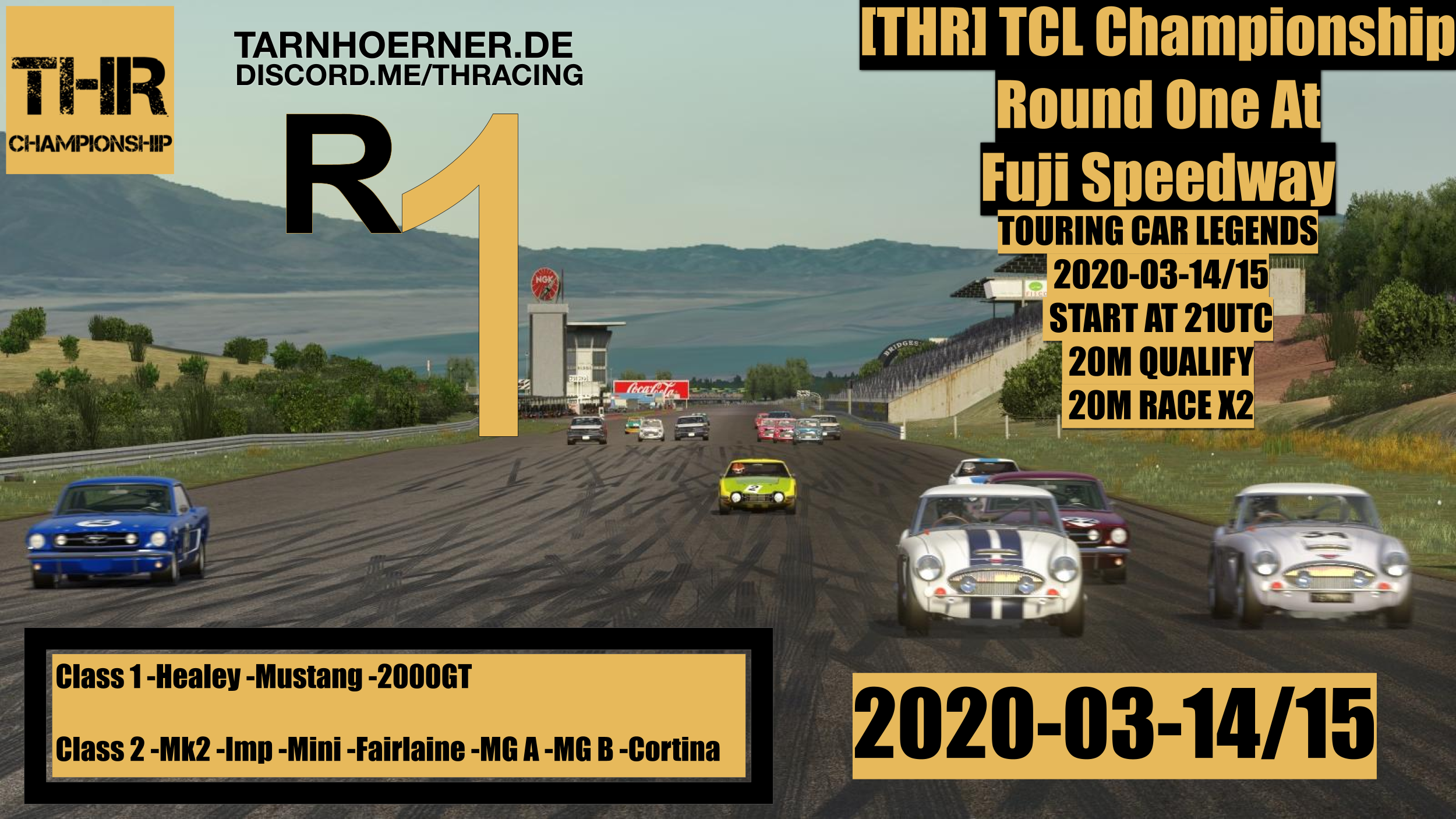
Fuji initially suggested that Duderei might set the terms. He won the opening race in the Ford Mustang 289 and followed it with fourth place in the second. Technoluddite brought the Toyota 2000GT into second place in the opener, while vegaguy took third and then second in the two races. The immediate honours were therefore shared more widely than the list of winners alone suggested.
pitman had begun with fifth place before winning the second race. His combined score of 50 left him third in the Class 1 running order, one point behind the shared lead on 51 held by Duderei and Vega. It was a narrow opening separation, but the next meeting supplied a clearer distinction between the principal Mustang runners.
At Longford, pitman won the first race and finished second in the other. Duderei's afternoon ran in the opposite direction: fifteenth in the opener, despite setting its fastest lap, then victory in the second race. His speed was plainly sufficient; the difficulty lay in making both results serve the same purpose. pitman's more complete meeting carried him into the Class 1 lead on 107 points, with Duderei second in the Championship on 97.
octavio67, meanwhile, was establishing a serious claim through repeated visits to the podium. Second and third in the Longford races placed him third in Class 1 on 94 points. The Mustang had won all four races held to that point, but its drivers were already offering different kinds of championship campaign: pitman's balanced returns, Duderei's pace and recoveries, and octavio67's regular presence among the first three.
The middle distance
Spa changed the identity of pitman's closest pursuer without changing the leader. octavio67 won the first race, then took eighth in the second, and emerged second in the Class 1 Championship on 142 points. pitman, fourth and fifth in the races, retained the lead on 152. He had taken neither victory nor podium from the meeting, but had kept both results useful.
That was an important contrast with Duderei's experience. In the first Spa race he was classified fifteenth after completing three of the four laps. Third place in the second race restored some ground, but the round supplied only 24 points. The recovery was real; so was the cost of needing it. His campaign had begun with the authority of a winner and now depended increasingly on retrieving difficult afternoons.
The other Spa victory went to MonSpaNur, whose fifth place in the opener and win in the second made this a substantial improvement on the earlier meetings. Stefano Zanella finished second in that latter race in the Toyota. These performances broadened the contest, taking prominent places away from the established leaders and showing that a useful championship result could no longer be assumed from early-season form.
Technoluddite's third and sixth places at Spa carried him into third in the Class 1 Championship on 131 points. His was not a campaign of victories, but the Toyota was maintaining a place in the leading argument. For pitman, the significance of the middle meeting was that several rivals had prospered without any one of them taking command. He remained the man against whom their progress had to be measured.
Monaco alters the prospect
Monaco gave Valentin Knechtel the victory which announced the strongest phase of his season. Having missed Fuji, he had opened his campaign with third place in the first Longford race, but it was now that the Toyota became a winning proposition. He won Monaco's first race and took eighth in the second. The result did not place him among the leading three in the raw Class 1 totals, yet it changed the character of his campaign from a collection of useful scores to one with demonstrated winning pace.
For pitman, Monaco required another kind of work. Twelfth place in the opener was followed by third in the second race, a recovery which preserved a respectable combined return. octavio67 recorded eleventh in both races, while Technoluddite took fourth and fifth. After the meeting, pitman led Class 1 on 194 points, octavio67 stood second in the Championship on 177, and Technoluddite was third on 175. The leader had increased his advantage over his nearest pursuer to 17 points, although the final discard still lay ahead.
The second Monaco race also supplied a reminder that the title contest did not monopolise the racing. Michi won in the Mustang, with eazywriter second. Neither performance belonged to the season-long struggle at the head of the table, but both affected the distribution of the afternoon's honours. Monaco had rewarded a new race winner, strengthened Knechtel's credentials and obliged the Championship leader to recover rather than command.
Hough's separate standard
In Class 2, the opening equality had been exact: Hough and Nat_Stevenson each left Fuji with 54 points. Harry was close behind on 51. Longford separated them, with Hough leading the class on 111 points, Harry second in the Championship on 108 and Nat_Stevenson third on 102. At this stage there was little suggestion of the margin Hough would eventually establish.
Spa was the decisive middle passage. Hough finished second overall in its first race and fourth in the second, his Ford Fairlane making a substantial impression on the combined field. His Class 2 total rose to 171 points. Nat_Stevenson, with eighth and ninth places overall, moved into second in the class Championship on 153, while Harry's absence left him third on 108. Hough's advantage was now 18 points, founded on an afternoon in which his class scoring and overall performance told the same story.
Monaco sustained that standard. Hough again finished second overall in the first race, then took tenth in the second. Nat_Stevenson's fifth and seventh places overall were a strong reply, and the Class 2 Championship gap remained 18 points: Hough on 228, Nat_Stevenson on 210. The challenger had matched the leader's round score without reducing the accumulated difference.
Their season would be settled by sustained returns rather than an overall race victory. Hough's two second places supplied its most visible distinction, but Nat_Stevenson's regular work in the field kept the contest honest. Harry, after the interruption at Spa, still had an opportunity to give his own campaign a more emphatic ending.
A proper answer at Deutschlandring
The final meeting brought the Class 1 champion and eventual runner-up into direct agreement about the leading places, if not their order. pitman won the first Deutschlandring race with Knechtel second; Knechtel won the second with pitman second. It was an authoritative conclusion from both men. The Toyota driver had completed his late-season rise, but the Mustang driver answered it without yielding a weak result.
With the discard applied, pitman became Class 1 champion on 209 points. His Monaco score of 42 was omitted from a raw total of 251. Knechtel's discarded entry was his zero from the missed Fuji meeting, leaving his 184 points intact and carrying him into the runner-up position. The rule thus had a substantial effect on the order behind the champion, while pitman's final pair of results gave his own success a suitably firm conclusion.
octavio67 took ninth in both Deutschlandring races and secured third in Class 1 on 178 points after discarding his 35-point Monaco score. Duderei was fourth in the final Championship on 176, with Technoluddite fifth on 175. Those small separations reflected a season in which the pursuers had found different strengths but had not matched pitman's complete return: three wins, two second places and a third, making six podiums in total.
Hough concluded with fourth place overall in both Deutschlandring races. After discarding his 54-point Fuji score, he was Class 2 champion on 231 points. Nat_Stevenson's final round score of 47 was discarded, leaving him runner-up on 210. Harry finished third overall in the last race and secured third in the class Championship on 201 points, his missed Spa meeting providing the zero-point discard. It was a fitting late distinction for a campaign which had been interrupted but not extinguished.
Class 1 belonged to pitman, whose winning speed and capacity to restore an afternoon gave him the soundest season; runner-up Valentin Knechtel supplied the strongest late challenge, while third-placed octavio67 earned his place through an early accumulation of podiums and victory at Spa. In Class 2, Ted Hough's sustained scoring and two overall second places carried him to the title ahead of the dependable Nat_Stevenson, with Harry completing the final podium after his last-race third overall. Both championships rewarded more than isolated brilliance. Over five meetings, the enduring distinction was between having a fine race and making a season of it.