Hough's Late Ascendancy
Ted Hough won GPL Championship 2 by turning a late run of victories into the strongest five-round account. Willian carried the points lead into the last meeting and won the concluding race, while Pocket Sized's early authority remained sufficient for third in the final reckoning.
The early measure
There were two ways of reading this Championship: by the points accumulated each Sunday, and by the five round scores which would remain when the season was done. For much of its course these readings suggested different degrees of strength among the leading drivers. Hough supplied the most insistent winning form, but Willian kept building a substantial account through repeated appearances near the front. Their eventual separation depended upon both the racing and the final application of the discarded-round rule.
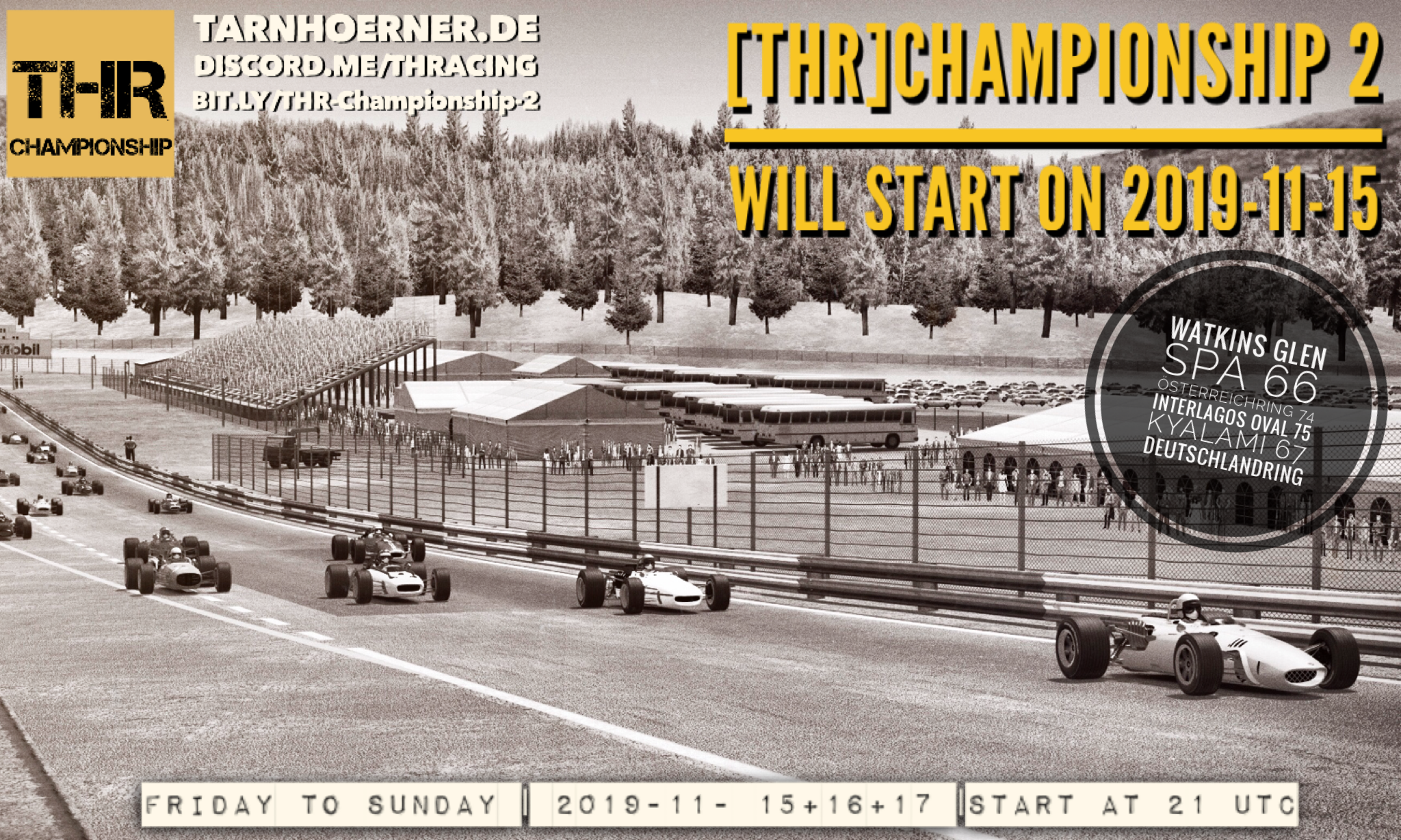
The format gave each of the six meetings two races, with a combined round score entering the Championship. The poorest round was removed only from the final table; the intervening totals therefore remained undiscarded. That distinction was no small matter in a season in which Hough missed the opening meeting and Willian contested every race. Yet the arithmetic alone does not explain the outcome. Hough still had to make his five appearances count, and it was the sustained quality of his later Sundays which gave the rule its decisive effect.
At Watkins Glen, however, the central figure was Pocket Sized. Gerard Clementine won the opening race in the Eagle T1G, ahead of Pocket Sized's Ferrari 312 and Willian's similar car. The second race changed the balance of the meeting. Pocket Sized won, Willian finished second, and pitman brought the Lotus 49 into third. Clementine, by contrast, was classified 12th after completing 12 of the 18 laps. The opening winner had demonstrated his speed, but Pocket Sized had assembled the better Sunday.
The early totals reflected that distinction: Pocket Sized led with 57 points, Willian followed on 51, and Clementine held third in the Championship with 43. It was an orderly beginning for the eventual third-placed driver, whose combination of a victory and a second place would prove difficult to improve upon.
A challenger arrives, a leader changes
Spa strengthened Pocket Sized's position while introducing the driver who would ultimately overturn it. Pocket Sized won the first race and finished second in the other, repeating the quality of his opening meeting. Hough began his season with third place and then victory in a Ferrari 312. The immediate advantage still belonged to Pocket Sized, but Hough had entered with a winning performance rather than a period of adjustment.
There was room for others to make their mark. Waffles finished second in the opening Spa race in the Honda RA300, an effective interruption of the Ferrari order. Willian's meeting was less productive: he was classified seventh after completing five laps in the first race, then sixth after another five laps in the second. His 88-point Championship total left him 26 behind Pocket Sized's 114. Hough's opening contribution was 54 points, useful but still well short of the established leader's account.
The Österreichring brought the first change at the head of the Championship. Pocket Sized was absent, and Willian used the opportunity with considerable economy, finishing second in both races. He did not need a victory to take command of the accumulated points. His 142 put him first in the Championship, with pitman second on 123 and Pocket Sized third on 114.
The victories themselves were divided between Hough and pitman. Hough won the first race, but in the second he was classified eighth after completing 11 of the 12 laps. That uneven meeting checked the progress suggested at Spa. Pitman's success in the other race gave the Lotus a conspicuous result and placed its driver among the leading figures in the points contest. Willian, meanwhile, had made the clearest advance of all: two second places had converted another driver's absence into a Championship lead.
The winning sequence
The character of the title fight altered at Interlagos Oval. Hough won both races in the Ferrari, bringing together the pace already apparent at Spa and the Österreichring with a complete meeting's return. These were no longer isolated successes separated by a less rewarding race. His combined round score was 60 points, and the pursuit acquired a steadier, more threatening shape.
Willian continued to resist through useful results rather than victories, taking third and fourth in the two races. Pitman had an especially sound meeting, finishing second and third. Consequently, Hough's double success did not immediately place him nearest the leader in the accumulated totals. Willian remained first in the Championship on 187 points, pitman second on 174, and Hough third on 161, 26 points behind the leader. The winning driver was advancing, but the men ahead were not surrendering their positions cheaply.
Pocket Sized also recovered something of his early form. Classified sixth after completing 22 laps in the opening 24-lap race, he finished second in the other. That second place restored him to the front group, although his early succession of top-two results had been interrupted. The Championship now had several distinct patterns: Willian's regular scoring, pitman's increasingly substantial challenge, Pocket Sized's effort to regain the initiative, and Hough's accelerating rate of victory.
Kyalami made Hough's pattern the most compelling. He again won both races, again setting the fastest lap in each. The result carried his current winning sequence to four races and his season's tally at that point to six victories. More importantly for the Championship, another 60-point Sunday moved him into second place in the accumulated standings.
Willian answered with two third places, sufficient to leave Kyalami still leading on 235 points. Hough had 221, a deficit of 14, while pitman stood third in the Championship on 220. The leader had retained his position, but Hough had become his closest pursuer. Willian's steadiness was keeping the contest open; Hough's repeated victories were steadily reducing the comfort it offered.
The final reckoning
Deutschlandring supplied a fittingly divided conclusion. Hough changed to a Lotus 49 and won the first race, with Clementine's Eagle second and Willian's Ferrari third. The champion-to-be had carried his winning form into different machinery, an emphatic final addition to the account built largely with Ferrari. In the second race Willian at last took a victory of his own, ahead of Clementine and Stefano Zanella in another Lotus. Hough finished fifth.
Willian's concluding success mattered beyond its points. His season had been constructed from second and third places, and victory gave that campaign a deserved sharper edge. He ended with one win, three second places and five thirds, nine podium appearances in total. Hough's completed record was of a different kind: seven victories from ten starts, with a third place completing his eight podiums. One driver had repeatedly secured a place among the leaders; the other had made winning the basis of his Championship.
The discarded round settled the difference between their final accounts. Willian accumulated 289 points before deductions, but his 37-point Spa score was removed, leaving 252. Hough's discarded entry was the zero from his absence at Watkins Glen, so his 271 points remained intact. The official margin was therefore 19 points in Hough's favour. The rule did not diminish the quality of Willian's season, but it meant that his additional scoring meeting could not remain part of the final comparison.
Pocket Sized's two fourth places at Deutschlandring completed a 242-point season and secured third in the Championship. His discarded entry was the zero from the missed Österreichring meeting. Although the later victories had belonged elsewhere, his early results retained their value: two wins and three second places gave him five top-two finishes across the completed season. He had established the opening standard, lost the lead through the middle phase, and preserved enough strength thereafter to stand on the final Championship podium.
The men who shaped the contest
Pitman's fourth place in the final Championship, on 220 points, should not obscure how closely he had figured in its development. The Österreichring victory and the podium results at Interlagos and Kyalami made him a persistent presence behind the leader. His own discarded score was the 38 points from Watkins Glen, reducing a raw total of 258. Five race podiums gave substance to a season which had remained prominent well into the closing stages.
Clementine's campaign followed a less even course, but its recovery was among the season's more satisfying features. Fourth and second at Kyalami were followed by two second places at Deutschlandring. He thus ended with three consecutive runner-up results, restoring the promise of his opening Watkins Glen victory and taking fifth in the final Championship on 204 points. The Eagle at the beginning and end of his season also supplied a welcome contrast to the Ferrari and Lotus machinery so often occupying the leading places.
Ted Hough was champion with 271 points, his decisive strength the ability to sustain a winning sequence and build the strongest counted season. Runner-up Willian, on 252, gave the contest its continuity through nine podium appearances and a victory in the concluding race. Pocket Sized took third with 242, his two early wins and five top-two results remaining a substantial achievement. It was a Championship in which regularity kept the argument alive, but repeated victory settled it.